[CA] Instructions: Language of the Computer
'컴퓨터 아키텍쳐' 시리즈
- [CA] Computer Abstractions and Technology
- [CA] Computer Abstractions and Technology
- [CA] Instructions: Language of the Computer
- [CA] Arithmetic for Computers
- [CA] The Processor - Unipipelined Datapath (1)
- [CA] The Processor - Unipipelined Datapath (2)
- [CA] The Processor - Unipipelined Datapath (3)
- [CA] Memory System (1)
- [CA] Memory System (2)
- [CA] Memory System (3)
✦ Instruction Set
- 컴퓨터가 사용 가능한 명령어 집합
- 컴퓨터마다 instruction set 다름
- but 공통 부분도 많음
- 초기 컴퓨터 → 간단한 instruction set
- 현대 컴퓨터도 간단한 instruction set 가짐
- CISC CPU (Intel, Apple) : 복잡한 명령어
- RISC CPU : 간단한 명령어
◆ MIPS Instruction Set
- instruction set 중 하나
- embedded 에서 사용
- 매우 간단 (ARM 과 유사하지만 더 간단)
✦ Operands
- Operands : 피연산자
◆ Register Operands
- MIPS : 32 bit 짜리 register 가 32개 → register file
- register : $0 ~ $31
- $t0 ~ $t7 ($8 ~ $15), $t8 ($24), $t9 ($25) → temporary 값 저장
- $s0 ~ $s7 ($16 ~ $23) → saved 값 저장
🗣
- CISC : 명령어 복잡 → Intel
- 명령어에 memory operand 가능
- RISC : 명령어 단순 → MIPS
- 명령어에 memory operand 불가능 (오래 걸림)
Design Principle 2 : Smaller is faster
- 명령어에 memory operand 불가능 (오래 걸림)
- Example : Read (register) Write (register)
- C
f = (g + h) - (i + j);
-
MIPS code

-
register 구조
| register | 역할 | register | 역할 |
| $0 | $zero (0) | $16 | $s0 (saved) |
| $1 | $at (Assembler Temporary) | $17 | $s1 |
| $2 | $v0 (result value) | $18 | $s2 |
| $3 | $v1 | $19 | $s3 |
| $4 | $a0 (arguments) | $20 | $s4 |
| $5 | $a1 | $21 | $s5 |
| $6 | $a2 | $22 | $s6 |
| $7 | $a3 | $23 | $s7 |
| $8 | $t0 (temporaries) | $24 | $t8 (temporaries) |
| $9 | $t1 | $25 | $t9 |
| $10 | $t2 | $26 | $k0 (kernel Reserved) |
| $11 | $t3 | $27 | $k1 |
| $12 | $t4 | $28 | $gp (global pointer) |
| $13 | $t5 | $29 | $sp (stack pointer) |
| $14 | $t6 | $30 | $fp (frame pointer) |
| $15 | $t7 | $31 | $ra (return address) |
- arguments → 인자 저장
- result value → 결과 값 저장
- temporaries → callee 에 의해 overwrite 가능
- saved → callee 가 저장해놓고 복구해야할 값
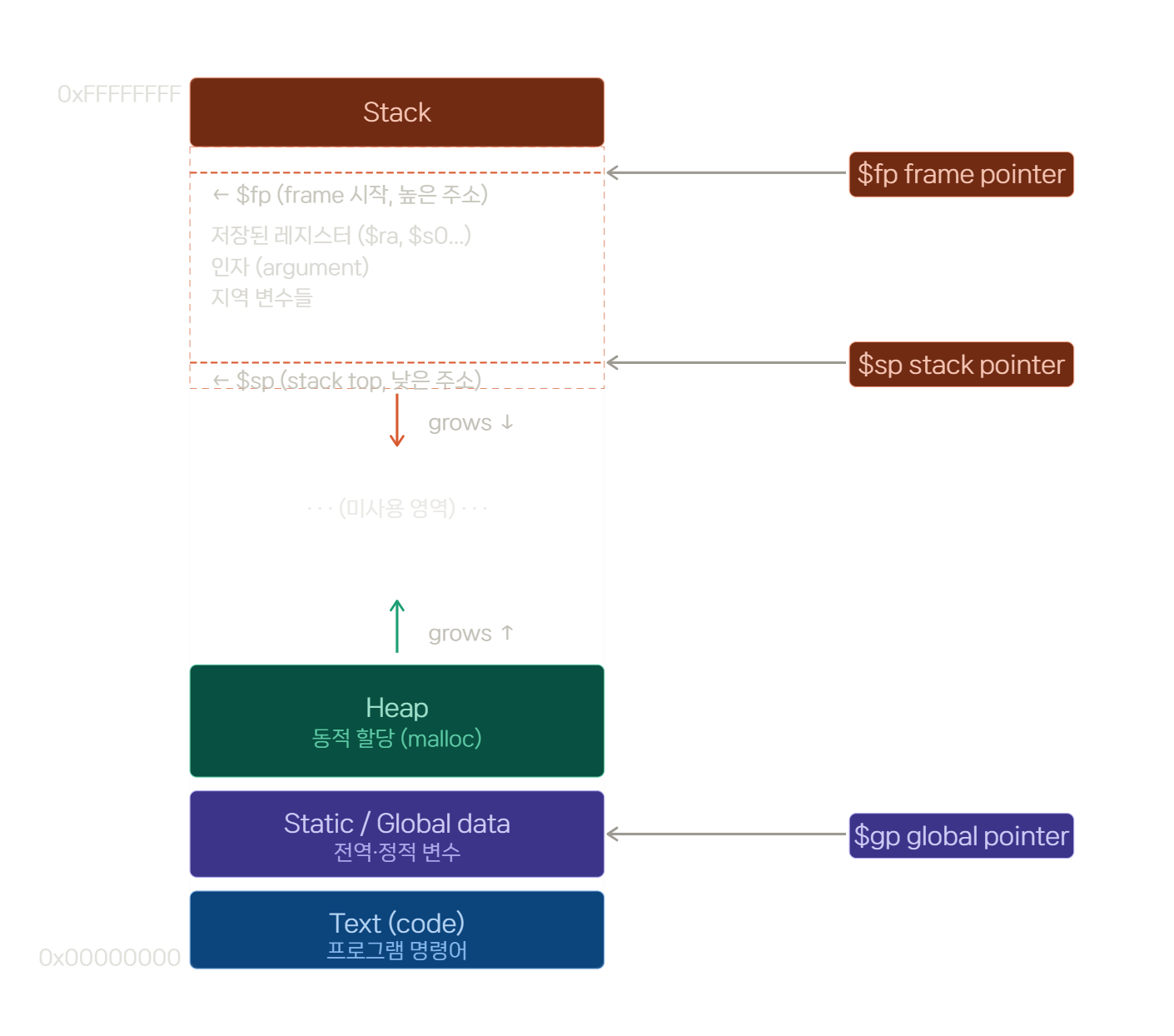
- global pointer → static data 위한 pointer
- stack pointer → stack 범위 지정 위한 pointer
- frame pointer → frame 위치 나타내는 pointer
- return address → procedure 가 돌아가야하는 address 저장하는 공간
◆ Memory Operands
- data 연산 위한 memory 접근
- load : register 가 계산하기 위해 memory 의 데이터 가져오기
- store : 계산 끝난 후 register 에 memory 에 저장하기
lw $t0, 32($s3) ; s3 (base register) 에서 32bit 떨어진 값을 t0 에 load
- word
- 컴퓨터가 한 번에 처리하는 bit 의 양
- memory 에 접근하기 위한 data 의 단위
- 꼭 word 단위가 아니라 byte 단위로 접근 가능 (32 bit : 1 word → 4 byte)
- byte = 8 bit
- Endian : MSB (부호 결정 bit) 의 위치에 따라
- Big Endian : MSB 가 앞에 등장 → MIPS
- 사람이 읽기 쉬움
- Small Endian : MSB 가 뒤에 등장 → Intel
- CPU 가 연산하기 쉬움
- Big Endian : MSB 가 앞에 등장 → MIPS
- Example : Read (memory, register) Write (register)
- C
g = h + A[8];
-
MIPS code

- 4 byte 짜리 8개 → 4 × 8 = 32 → offset
- Example : Read (memory, register) Write (memory)
- C
A[12] = h + A[8];
-
MIPS code

- 4 byte 짜리 8개 → 4 × 8 = 32 → offset
- Local Data on the Stack
◆ Immediate Operands
- 상수 (constant) 가 필요할 때가 있음
- memory 에 constant 저장할 때
- constant 를 명령어에 불러올 때
Design Principle 3 : Make the common case fast
- substract 명령어 존재 X
addi $s2, $s1, -1: 음수를 더하는 거로 대체
- Constant Zero
- 항상 0 으로 설정되어 있는 값
$zero- overwrite 불가능
- register 옮길 때 사용
add $s2, $s1, $zero
- Unsigned Binary Integers
- 범위 : 0 \sim 2^n - 1
- 32 bit 사용
- 2’s Complement Signed Integers
- bit 31 은 부호 (sign) bit
- 1 : 음수
- 0 : 양수 (& 0) - -(-2^{n-1}) 표현 불가 → negation 해도 자기 자신 나옴 - 특정 숫자
- 0 : 0000 0000 …. 0000
- 1 : 1111 1111 …. 1111
- 최대 : 0111 1111 …. 1111
- 최소 : 1000 0000 …. 0000
- 32-bit Constant
- 대부분의 상수는 작기에 16 bit 만으로 충분하다
- 가끔 32 bit 상수를 써야할 때
lui rt, constant: rt 의 왼쪽 16 bit 를 constant 값으로 채움. 오른쪽 16 bit 는 0 으로 채움

✦ Operation
- Operation : 연산자
◆ Arithmetic Operation
- add (더하기), subtract (빼기) → operand 3개
- 2 sources & 1 destination

- 2 sources & 1 destination
- 모든 산술 연산자는 같은 형태를 가짐
Design Principle 1 : Simplicity favours regularity
- Example
- C
f = (g + h) - (i + j);
- MIPS code

◆ Signed Negation
- bit flip (complement) 후 + 1
- ex)
- 2 : 0000 0000 …. 0010
- -2 : 1111 1111 …. 1110
◆ Sign Extension
- 같은 숫자를 값 보존 + 더 많은 bit 써서 표현하기
- MSB 를 왼쪽에 붙임 (arithmetic)
- cf) unsigned 면 0 붙임 (logical)
- MIPS instruction set
addi: immediate 값 extendlb,lh: load 된 byte / halfword 를 extend- load byte : load 자체는 1 byte → 나머지 byte 는 extend
- load halfword : load 자체는 2 byte → 나머지는 extend → 결과적으로 4 byte 로 extend
beq,bne: displacement 를 extend- displacement : 분기 명령어 (branch instruction) 의 목적지 주소를 인코딩 하는 값
beq $1, $2, 100
◆ Logical Operations
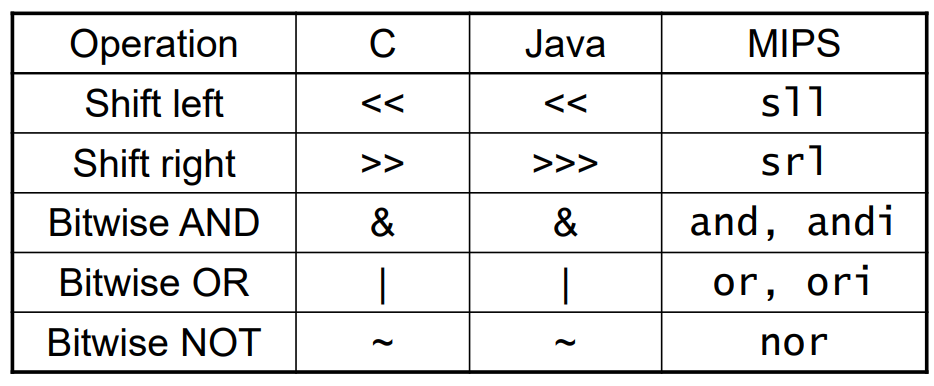
- Shift Operations

- shamt (shift amount) : shift 할 bit 수
- 총 32 bit이므로 2^5 → 5 bit 할당
- shift left logical -
sll- ← 이동 & 0 으로 채우기
- 2배
- shift right logical -
srl- → 이동 & 0 으로 채우기 (logical)
- \frac{1}{2} 1. AND Operation
- bit 를 mask 할 때 : 둘 다 1 일 때만 선택
and $t0, $t1, $t2- OR Operation
- bit 를 include 할 때 : 하나라도 1 이면 1
or $t0, $t1, $t2- NOT Operation
- bit 를 invert 할 때 : 0 ↔ 1
not명령어 존재 X →nor로 표현nor $t0, $t1, $zero와 같이 표현
a NOR b==NOT (a OR b)
◆ Conditional Operation
- condition 이 참이면 label 된 명령어로 branch 하기
- 거짓이면 계속 진행
beq rs, rt, L1: rs = rt 면 L1 으로 가기bne rs, rt, L1: rs ≠ rt 면 L1 으로 가기j L1: 무조건 L1 가기- Example
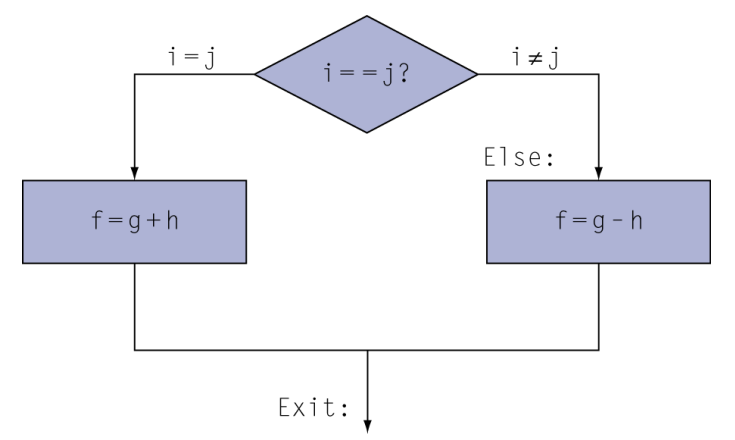
- If Statement
- C
- If Statement
if (i == j)
	f = g + h;
else
	f = g - h;
- MIPS code 
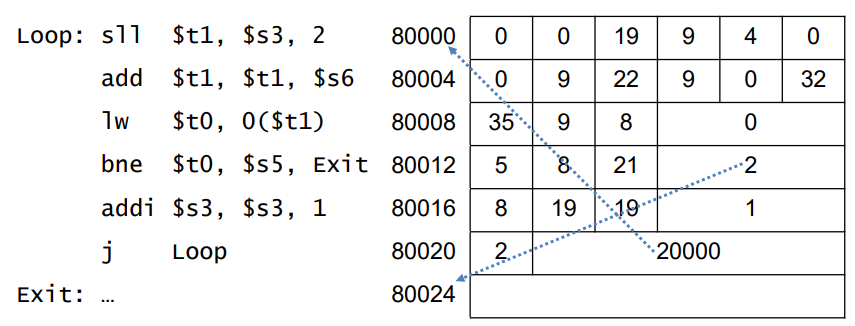
- Loop Statements
- C
while (save[i] == k) i += 1;
- MIPS code 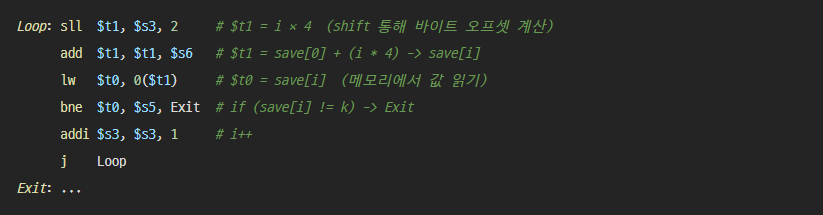
◆ More Conditional Operations
- 조건이 참 → 결과 1 설정
- 조건이 거짓 → 결과 0 설정
-
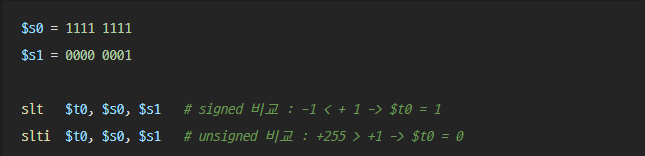
slt (Set on Less Than)

beq,bne와 함께 사용
→ why blt , bge 가 존재하지 않을까?
Hardware 에서 비교의 구현은 =, ≠ 보다 느리다.
Common case 인 beq, bne , slt , slti 만 구현
- Signed 비교 :
slt,slti - Unsigned 비교 :
sltu,sltui→ compiler 자체는 저장되어 있는 값이 signed 인지, unsigned 인지 character 인지 모름
◆ Byte / Halfword Operations
- bitwise 이용해 byte / halfword 구할 수 있지만, 편의 위한 operation
- MIPS 의 byte / halfword 단위 load / store
- 문자열 처리
| byte | halfword | |
| sign extend | lb rt, offset(rs) |
lh rt, offset(rs) |
| zero extend | lbu rt, offset(rs) |
lhu rt, offset(rs) |
| store | sb rt, offset(rs) |
sh rt, offset(rs) |
◆ Sychronization Operation
- 2 processor 가 memory 공간 공유
- P1 이 쓰고, P2 가 읽음
- sychronize 해야 침범 X
- 단일 instruction
- Load linked :
ll rt, offset(rs) - Store conditional :
sc rt, offset(rs)ll이후 위치 변경 X → rt = 1ll이후 위치 변경 O → rt = 0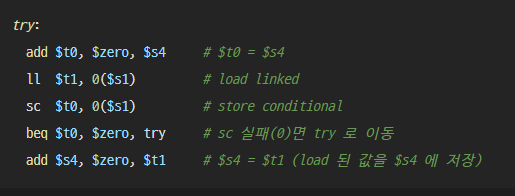
✦ Instruction Format
◆ Representing Instruction
- 명령어는 binary 형태로 인코딩 됨 → machine code
- MIPS 명령어
- 32-bit 명령어로 저장
- regularity
- Register number
- $t0 ~ $t7 → $8 ~ $15
- $s0 ~ $s7 → $16 ~ $23
- $t8 = $24 / $t9 = $25
◆ Stored Program Computers
- instruction 은 data 처럼 binary 로 표현된다.
- instruction & data 모두 memory 에 저장된다
- Binary compatibility (바이너리 호환성) : 컴파일된 프로그램이 서로 다른 컴퓨터에서도 동작할 수 있게 해줌
◆ R-format Instruction
- register 간 연산
-
형태

- op : 명령어 코드 (opcode)
- rs : 첫 번째 source register number
- rt : 두 번째 source register number
- rd : destination register number
add $1(rd), $2(rs), $3(rt)
; $1 = $2 + $3
; rd = rs + rt
-
Example
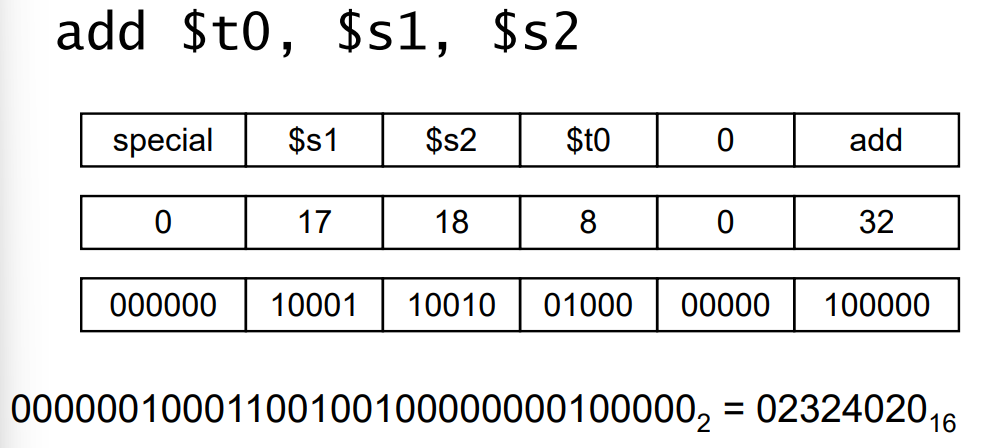
- 명령어 : binary → hexadecimal 형태로 바꿀 수 있음
◆ I-format Instruction
- memory or immediate 사용 연산
-
형태

- op : 명령어 코드 6 bit
- rs : source register
- rt : source or destination → instruction 따라
- 나머지 16 bit
- Constant (상수) : -2^{15} \sim 2^{15}-1
- Address offset : rs (base address) 에 더할 offset
Design Principle 4 : Good design demands good compromises
- Branch Addressing
- 앞 or 뒤쪽 branch 로 이동
- Target Address (TA) = PC + (offset × 4)
◆ J-Format Instruction
- Jump (
j,jal) 목표는 code 의 어느 곳이든 가능하다 -
형태

- op : 명령어 코드 6 bit
- address : 명령어에 full address 인코딩
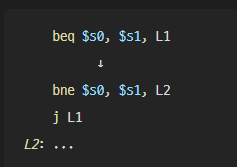
- 너무 branch 가 멀어 16-bit offset 으로 불가능 → assembler 가 code 다시 씀
◆ Basic Blocks
- 아래 조건 만족하는 명령어의 연속
- 끝을 제외하곤 branch X
- 처음을 제외하곤 branch 목적지 X
- 한 번 들어오면 끝까지 실행 → compiler 최적화 기준
✦ Procedure
◆ Procedure Calling Steps
- Register 에 함수에 넘길 parameter 저장 (
$a0~$a3) - 함수로 점프 (
jal) - 함수가 사용할 stack 공간 확보 (
$sp감소) - 함수 실행
- result 를 register 에 저장 (
$v0,$v1) - 함수를 호출한 곳으로 복귀 (
jr $ra)
◆ Procedure Call Instructions
-
함수 호출 : jump and link
jal procedureLabel→ Label 로 이동 + 이 다음줄 주소를$ra에 저장 -
함수 복귀 : jump register
jr $ra→ 저장해놓은$ra로 돌아가기
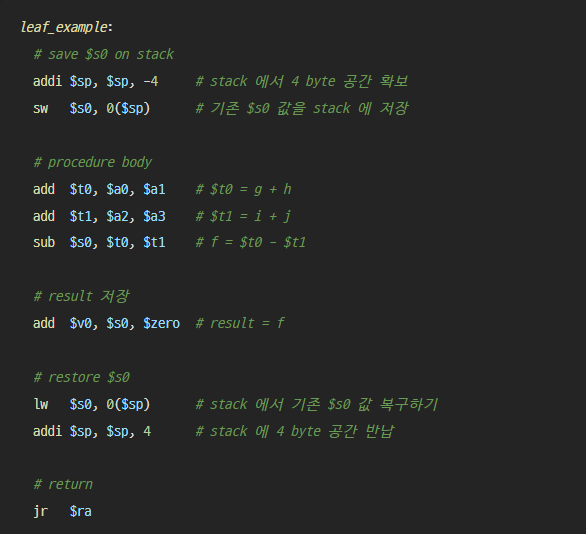
◆ Leaf Procedures
- 다른 함수를 호출하지 않는 함수
- C code
int leaf_example (int g, h, i, j) { // g($a0), h($a1), i($a2), j($a3)
	int f; // f($s0) -> stack 에 저장
	f = (g + h) - (i - j);
	return f;
}
- MIPS code
◆ Non-Leaf Procedures
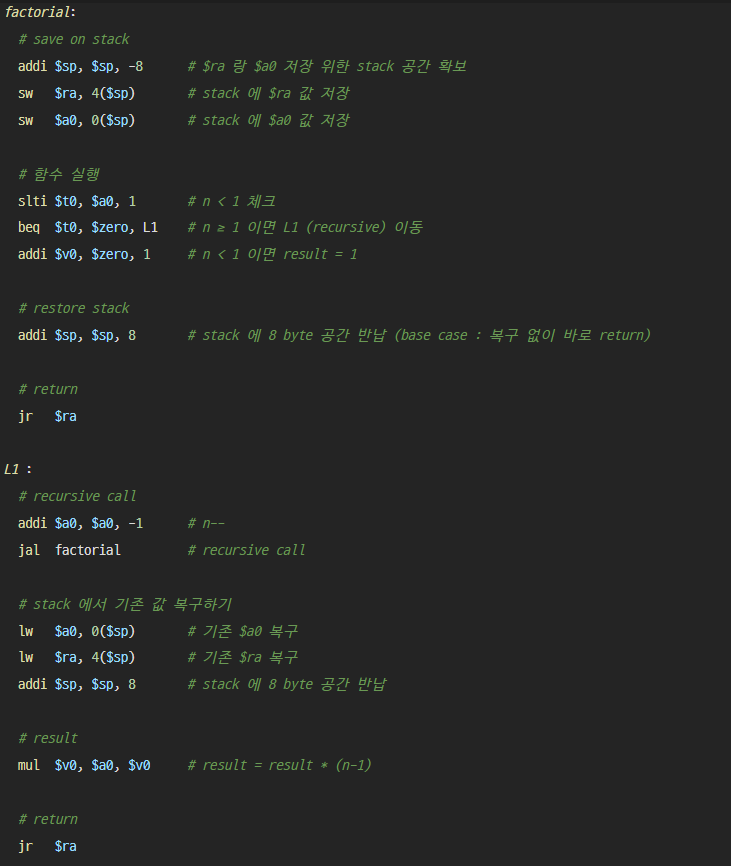
- 다른 함수를 호출하는 함수
- nested call 이 필요함 → stack 에 저장해야 할 것
- return address
- 함수 호출 이후 사용해야 할 $a, $t
- call 이후 stack 에서 복구
- C code
int factorial (int n) { // n($a0)
	if (n < 1) return 1;
	else return n * factorial(n-1);
	// result($v0)
}
- MIPS code
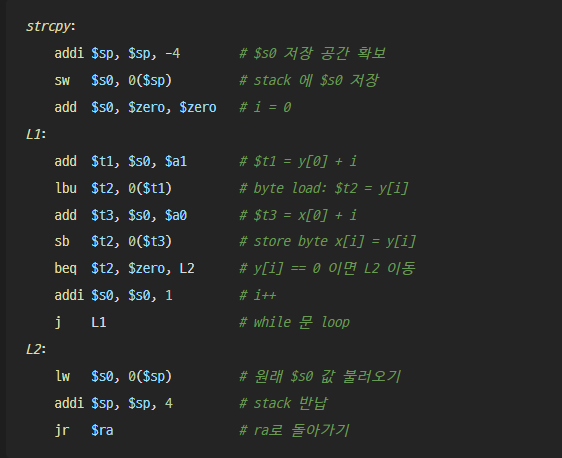
◆ String Copy
- C code
null로 끝나는 string
void strcpy(char x[], char y[]) { // $a0 (x 주소), $a1 (y 주소)
	int i ; // $s0 (i)
	i = 0;
	while ((x[i] = y[i] != '\0')
		i += 1;
	}
}
- MIPS code
◆ Target Addressing
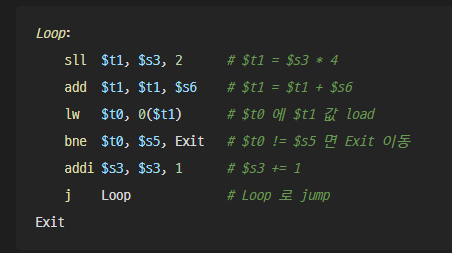
$s3 ≠ $s5 일때 까지 $s3++
✦ Addressing Mode
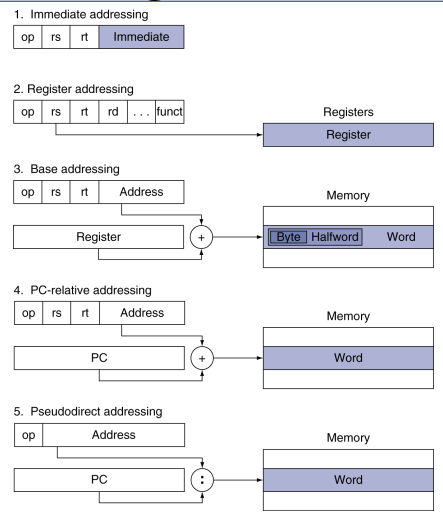
✦ How Program Works?
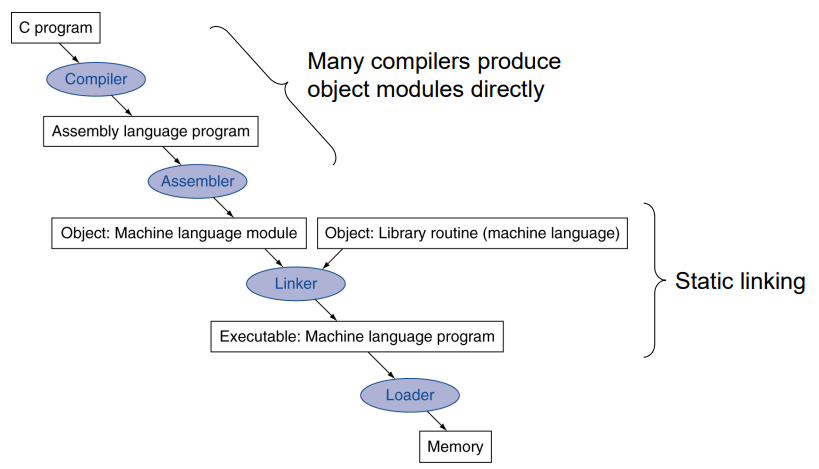
◆ Assembler Pseudoinstructions
- 대부분의 assembler 명령어는 machine 명령어와 1 대 1 대응
-
Pseudoinstructions : 프로그래머 편의를 위한 가상 명령어
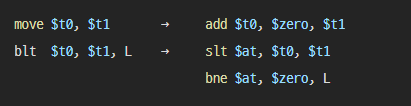
$at($1) : assembler 가 임시로 사용하는 register
◆ Object Module 생성
foo.c→foo.o- 소스코드 → 기계어로 번역
- 내용
- Header : 모듈 내용 설명
- Text segment : 번역된 명령어들
- Static data segment : 프로그램 수명 동안 유지되는 데이터
- Relocation info (R.I) : loaded program 의 절대 주소에 의존하는 내용 처리 정보
- Symbol table (S.T) : global 정의 & 외부 참조
- Debug info (D.I) : source code 와 연결 정보
◆ Object Module Linking
- 여러 Object Modue 연결 → executable 만듬
- Segment 합침
- label 주소 결정
- 위치 의존적 참조 & 외부 참조 수정
- Linking 종류
- Static Linking
- 라이브러리 함수 미리 link / load
- 처음엔 느린데 실제 작동 중엔 빠름
- 단점 : 사용하지 않을 함수까지 load
- Dynamic Linking
- 라이브러리 함수 실제 호출 시 link / load
- 신 버전 라이브러리 사용 가능
- Lazy Linkage
- 처음부터 linking 하지 않고 실제로 호출되는 것만 linking
- 첫 호출 → 모든 routine 호출 → overhead 높음
- 그 다음부터는 간접 점프 → overhead X
- Immediate Linkage
- Static Linking
◆ Loading Program
- 실행 파일 memory 에 올리기
- header 읽어 segment 크기 확인
- 가상 주소 공간 생성
- text(code) 와 초기화된 data 메모리에 복사
- stack 에 argument 설정
- register (
$sp,$fp,$gp) 초기화 - 시작 루틴으로 jump
- argument 를
$a0, .. 등에 복사 main호출main이 return 하면exit시스템 콜 시행
- argument 를
✦ Java Application
- CPU Time 10배 : Poor performance
- 어디서나 실행가능 : Portability
- Intermediate language
- Java/JIT compiled code 는 JVM interpreted 보다 빠르다
✦ Example
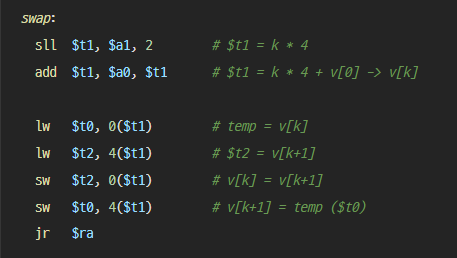
◆ Swap
void swap(int v[], int k) {
	int temp;
	temp = v[k];
	v[k] = v[k+1];
	v[k+1] = temp;
}
◆ Sort
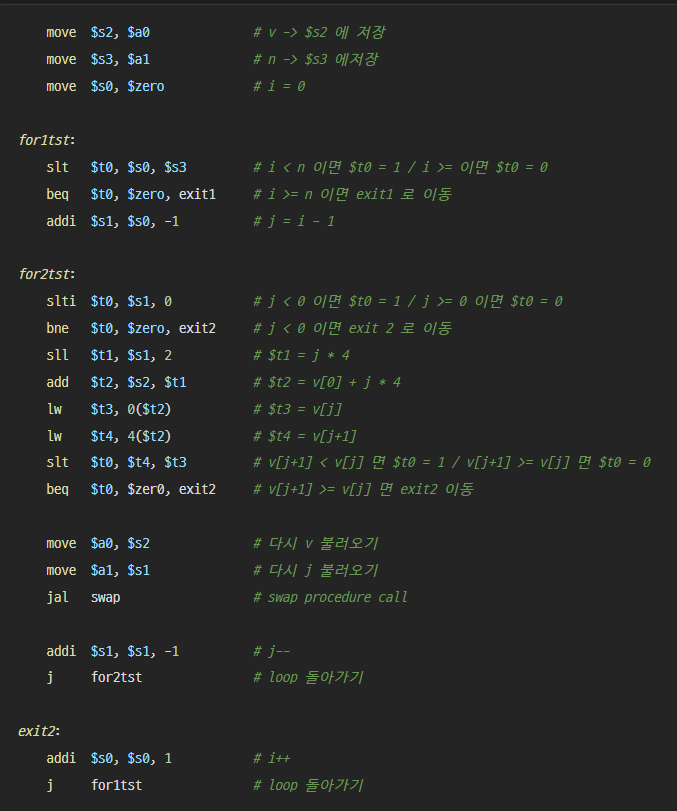
- insertion sort
void sort(int v[], int n ) {
	int i, j;
	for (i = 0; i < n; i++) {
		for (j = i - 1;
				 j >= 0 && v[j] > v[j+1];
				 j--) {
			swap(v, j);
		}
	}
}
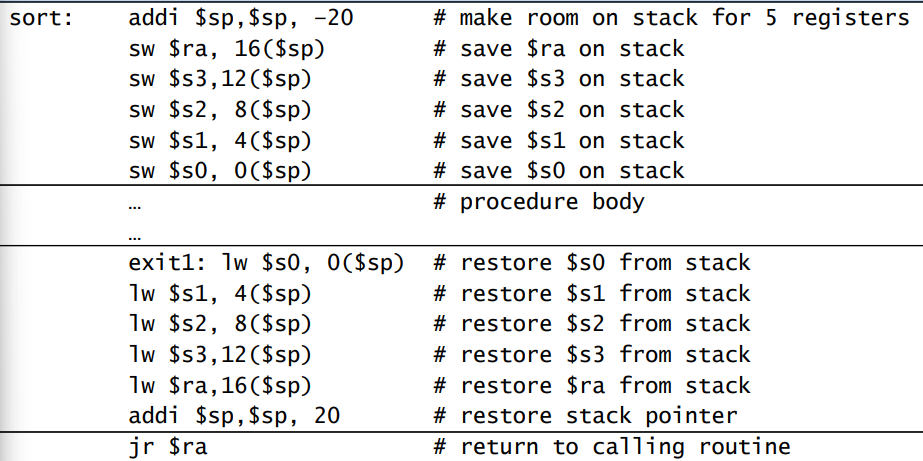
- 전체 과정
◆ Clearing Array
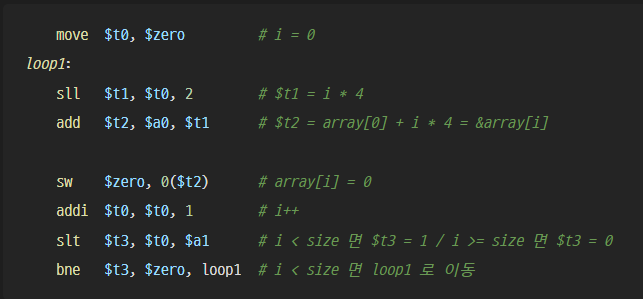
- array[index]
clear1(int array[], int size) {
	int i;
	for (i = 0; i < size; i++) {
		array[i] = 0;
	}
}
- *array
clear2(int *array, int size) {
	int *p;
	for (p = &array[0]; p < &array[size]; p++) {
		*p = 0;
	}
}
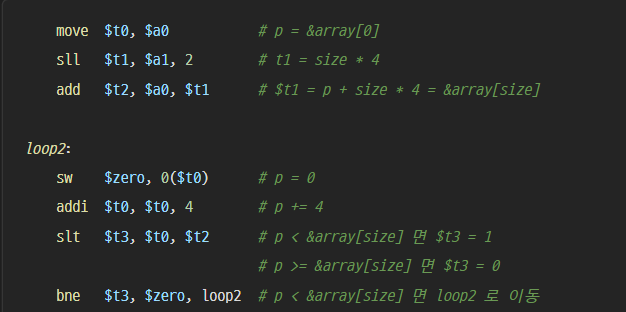
→ pointer 가 더 안전하고 명확함
✦ Assembly Language
◆ MIPS
- typical of RISC ISAs
◆ ARM
- 가장 인기 있는 embedded core
- MIPS 와 유사한 ISA
- MIPS 와 비교
| ARM | MIPS | |
|---|---|---|
| 발표 연도 | 1985 | 1985 |
| 명령어 크기 | 32비트 | 32비트 |
| 주소 공간 | 32비트 플랫 | 32비트 플랫 |
| 데이터 정렬 | 정렬됨 | 정렬됨 |
| 데이터 주소 지정 모드 | 9 | 3 |
| 레지스터 | 15 × 32비트 | 31 × 32비트 |
| 입출력 | 메모리 맵 | 메모리 맵 |
→ 기본으로 제공하는 register 수가 더 적음
- flag register : Negatice, Zero, Carry, Overflow
- 산술 / 논리 연산 수행 시 자동으로 설정
-
조건 분기 시 flag register 확인해 실행 → 분기 명령어 필요 X 효율적!
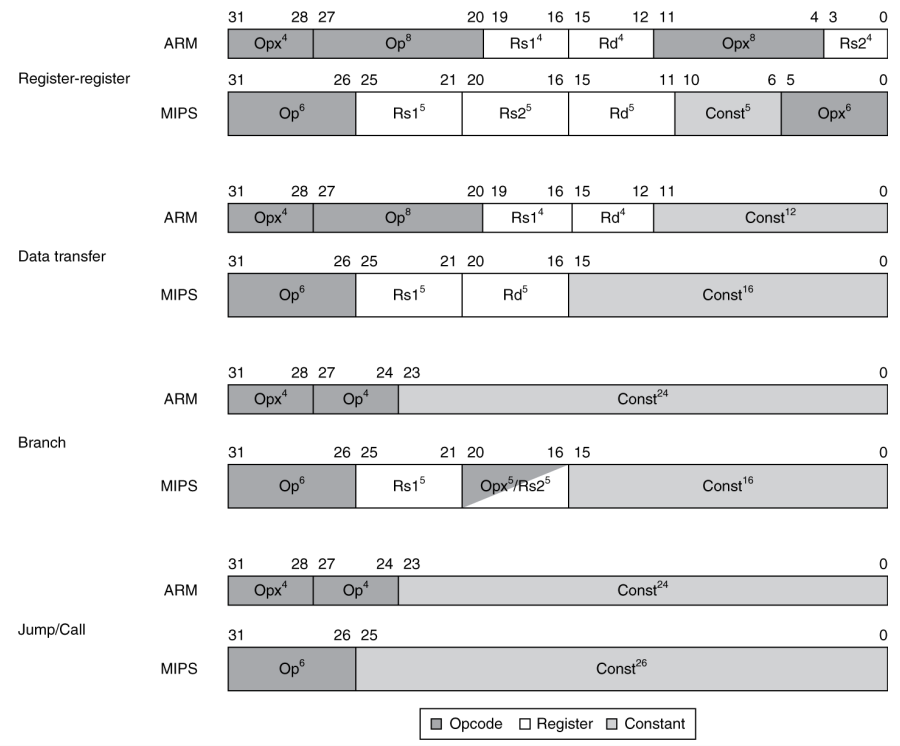
- ARM v7 → v8 바뀌면서 MIPS 와 더 닮아짐
◆ Intel x86 ISA
-
기본적으로 8개의 register 사용
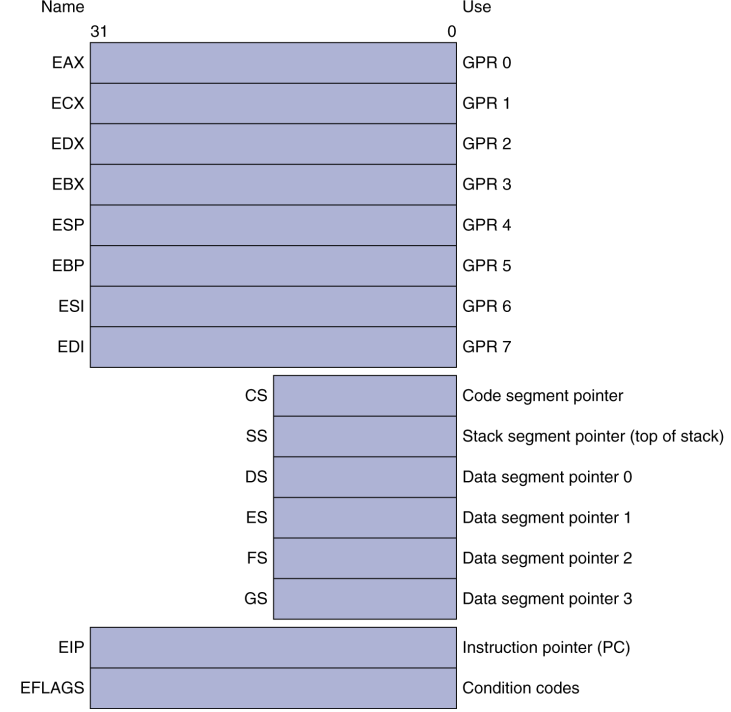
- Instruction
sourcedestination - Instruction code 길이가 다름
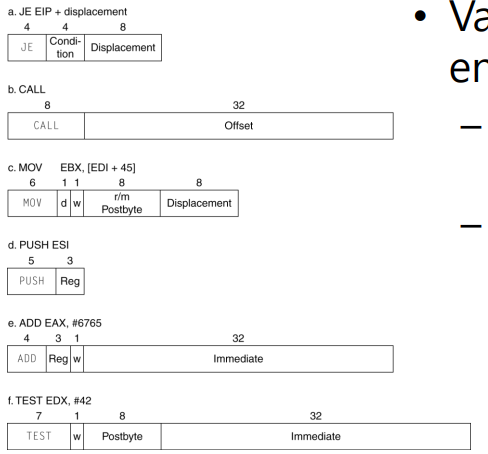
✦ Pitfall (함정) & Fallacy (오류)
◆ Fallacies
- 강력한 명령어 → 더 높은 성능
- 더 적은 명령어 필요
- but 복잡한 명령어 → 구현 어려움
- 단순한 명령어로 빠른 코드 만드는게 더 좋음!
- 고성능을 위해 Assembly 언어 차용
- but 현대 compiler 는 현대 Processor 더 잘 다룸
- code line ↑ → error ↑, 생산성 ↓
- Backward compaltibility
- Instruction Set 은 변하지 않음
- but 실제로는 계속 추가
- 그러나 예전에 만든 프로그램은 새로 만든 CPU 에서도 돌아감
◆ Pitfall
- 순차적인 word 는 순차적 address 에 있지 않음
- 1 이 아니라 4 씩 증가해야 함!
- Procedure 가 return 후 자동 변수에 대해 pointer 유지하는 것
- ex) argument 통해 pointer 다시 전달
- stack 이 pop 되면 pointer 는 무효가 됨 → dangling pointer
✦ Conclusion
- Design Principles
- Simplicity favours regularity
- Smaller is faster
- Make the common case fast
- Good design demands good compromises
- Layers of software / hardware
- Compiler - Assembler - Hardware
- MIPS : typical of RISC ISAs
| 명령어 분류 | MIPS 예시 | SPEC2006 int | SPEC2006 FP |
|---|---|---|---|
| Arithmetic | add, sub, addi | 16% | 48% |
| Data transfer | lw, sw, lb, lbu, lh, lhu, sb, lui | 35% | 36% |
| Logical | and, or, nor, andi, ori, sll, srl | 12% | 4% |
| Conditional Branch | beq, bne, slt, slti, sltiu | 34% | 8% |
| Jump | j, jr, jal | 2% | 0% |
공유하기
Twitter Facebook LinkedIn글 이동
시리즈 이동

Comments