[PL] Names, Bindings, Type Checking, and Scopes
'프로그래밍 언어' 시리즈
- [PL] Preliminaries
- [PL] Names, Bindings, Type Checking, and Scopes
- [PL] Data Types
- [PL] Expressions and the Assignment Statement
- [PL] Statement-Level Control Structures
- [PL] Subprogram
- [PL] Implementing Subprograms
- [PL] Exception Handling and Event Handling
- [PL] Abstract Data Types and Encapsulation Concepts
- [PL] Object-Oriented Programming
✦ Introductions
◆ Imperative Languages (명령형 언어)
- 변수 (variable) → memory cell 의 추상화
- 속성 : data type, scope, life time, type checking ,initialization 등
- 실제 세계 & data type 과 얼마나 잘 match?
✦ Names
- 이름 (name) : 프로그램에서 entity 식별 위해 사용하는 문자열
- 프로그램에서 이름 짓는 것은 중요하면서도 어렵다.
◆ Name Forms
- 이름 길이
- 초창기 언어들에는 글자 수 제한 O
- 요즘 언어들은 글자 수 제한 X
- 대소문자 구별 ex) C, C++ 구별 O
◆ Special Words
- Keyword : 특정 context 에서만 의미 가지는 단어
- Reserved word (예약어) : 항상 의미 가지는 단어 → 이름으로 사용 X
ex)
if,while,return,class
✦ Variables
- Variavles (변수) : 컴퓨터 memory cell 추상화
◆ Name (이름)
- 이름을 가짐 (identifier)
◆ Address
- 변수가 위치한 메모리 주소
- 전역 변수 vs. 지역 변수 똑같은 이름
→ 지역 변수 먼저
- scoping rule : 내가 속한 지역에서 먼저 변수명 찾음 → 없으면 지역 밖에서 찾음
- aliase : 한 memory cell 에 이름이 여러 개 → debugging 어려움 ex) pointer
◆ Type
- 값의 범위 & 사용 가능 연산자 정의
- Assembly 언어는 type 이 없음
◆ Value
- memory cell 에 들어 있는 값
a = a + 1;
- 왼쪽 a → l-value (left, location) : 변수의 메모리 주소
- 오른쪽 a → r-value (right, real) : 변수에 저장된 실제 값
✦ Binding
- Binding (바인딩) : 어떤 속성 값을 결정하는 것
- 어떤 엔티티 (entity) & 속성 (attribute) 연결
- 어떤 연산 (operation) & 기호 (symbol) 연결
◆ Binding Time
- 어떤 때에 Binding 이 일어나는가?
- Language design time : 언어 설계 시
- 언어를 설계할 때
*를 곱하기 연산자로 정하기 1. Language implementation time - 데이터 타입 (int, float) 이 가능한 값의 범위 (word size) 에 binding
- integer 는 항상 word size 로 저장
- 언어에 대한 compiler 를 만들 때
- Complie time
- 변수의 type 결정 (a 는 int, b 는 float)
- type binding time → in C 1. Link time
- main & subroutine 있을 때 main - sub binding 하는 시간 1. Load time
- 실행되기 위해 변수가 memory 에 올라오는 시간
- 이때 변수는 local X global O
- 빈 memory 에 올라감
- global 변수에 대한 attribute binding 시점 1. Run time
- 실제 실행 중에 변수의 value binding 이 일어나는 시점
- local 변수 attribute binding 시점
| C | Python | |
|---|---|---|
| Name | compile time | run time |
| Type | compile time | run time |
| Address | load time (전역 변수) run time (지역 변수) |
run time |
| Value | load time (전역 변수) run time (지역 변수) |
run time |
| Lifetime | run time | run time |
◆ Type Binding
- 변수의 type 이 언제 binding 되는가?
- 언어마다 다름
- C → Compile time (static type binding)
- Python → Run time (dynamic type binding) 1. Static type binding
- 변수 선언 시 type 결정
- C, C++, Java
- language rule 에 의해 변수 이름에 이미 type 이 할당된 언어 존재 ex) in FORTRAN → 변수명이 I, J, K 면 int type
- Dynamic type binding
- 실제 assignment 일어날 때 (run time) type 결정
- JS, Python, Ruby
- 장점 : Flexibility (Generic 프로그램 작성 쉬움)
- 단점 : Compile 시 type error 발견 어려움
◆ Storage Binding
- 변수의 address 가 언제 binding 되는가?
- Static variable
- global 변수
- 프로그램 시작 전 미리 할당 (load time) 1. Stack dynamic variable
- procedure 안에 만들어진 local 변수
- type 할당 → compile time
- 함수가 호출되었을 때 (run time) address 할당
- recursion 을 위해 자주 사용
- 같은 stack 공간 재사용 가능 1. explicit Heap Dynamic Variale
malloc과 같은 함수로 프로그래머가 직접적으로 할당하는 변수- 프로그래머가
free할 때까지 사용하기에 stack 이 아닌 heap 에 저장 - pointer 변수 통해 참조 1. implicit Heap Dynamic variable
- 프로그램에 의해 자동으로 값이 assign 될 때에만 address 할당
- 자동적 할당 (PHP, JavaScript) 등
- 그때 그 type 에 맞게 memory 할당
✦ Type Checking
- operator 와 operand 들이 서로 호환 가능한 타입인가?
- 호환 불가능 → compiler 가 error 알림
- 몇몇 compiler 는 자동 형변환 (coercion) 통해 호환 가능하게 만듬
✦ Strong Typing
- Strongly typed language
- 프로그램의 모든 변수가 static type binding 인언어
- type error 항상 발견 가능
- C, C++ : strong typed language X
→
scanftype checking 안함
✦ Lifetime & Scoping
◆ Lifetime
- 시간적 개념
- 변수가 특정 memory cell 과 binding 되어 있는 시간
- global 변수 : 프로그램 시작 전부터 끝날 때까지
- local 변수 : 선언된 procedure 안까지
◆ Scope
- 공간적 개념
- 변수가 visible (사용 가능) 한 영역
- global 변수 : 프로그램 전체
- local 변수 : local 변수가 선언된 procedure 안
✦ Scope
◆ Static Scope
- 대부분의 언어가 사용
-
계층적 구조 - scope 가 nest 된 구조
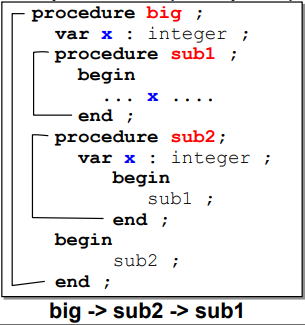
-
Static Scoping rule : 내 지역 안에서 찾아보고 없으면 더 밖의 영역 찾는다. ex) 서강대에 없으면 대흥동에서 찾고, 없으면 마포구에서 찾고, 없으면 서울에서 찾고, 없으면 한국에서 찾고, 없으면 global 에서 찾기
- compile time 에 결정
- procedure 아니어도
{}통해 nest 가능 - nested subprogram 가능 (Ada, JavaScript, Fortran, F#, Python)
- 함수 내부에함수 선언
- 문제점
- too much access
-
잘못된 함수 호출 compiler 가 잡지 못함
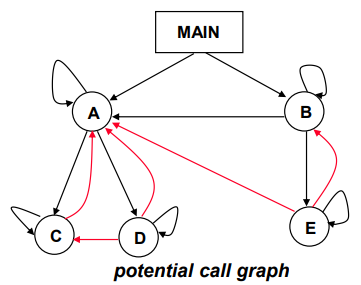
- visible 하면 안되는 것들이 보임
◆ Dynamic Scope
- 변수의 scope → subprogram 의 호출 순서 기반 결정
- run-time 에 결정
- 자신을 호출한 함수의 scope 를 찾음
- parent
- static parent : 구조적으로 외부에 있는 함수 (ex.
sub1의 static parent 는big) - dynamic parent : 함수를 실제로 호출한 함수 (ex.
sub1의 dynamic parent 는sub2)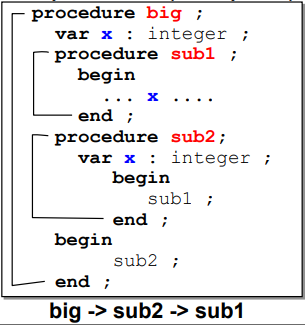
- static parent : 구조적으로 외부에 있는 함수 (ex.
- 거의 사용되지 않는 방법
- 장점 : parameter 넘길 필요 X
- 단점 : type checking 어려움, 신뢰성 ↓
✦ Referencing Environments
-
어떤 Statement 에서 visible 한 변수들의 집합
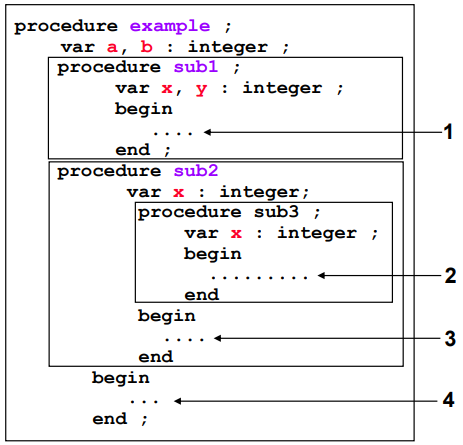
x,y→ sub1 /a,b→ examplex→ sub3 /a,b→ examplex→ sub2 /a,b→ examplea,b→ example
✦ Named Constant
- storage binding 이 일어날 때 value binding 이 동시에 + run time 중 값이 바뀌지 않음
#define과는 다른 방식 : #define 은 전처리 단계- Readability ↑
✦ Variable Initialization
- 초기화
- 대부분의 언어 : storage binding + value binding
- 수행 도중 value 바뀔 수 있음
공유하기
Twitter Facebook LinkedIn글 이동
시리즈 이동

Comments