[PL] Implementing Subprograms
'프로그래밍 언어' 시리즈
- [PL] Preliminaries
- [PL] Names, Bindings, Type Checking, and Scopes
- [PL] Data Types
- [PL] Expressions and the Assignment Statement
- [PL] Statement-Level Control Structures
- [PL] Subprogram
- [PL] Implementing Subprograms
- [PL] Exception Handling and Event Handling
- [PL] Abstract Data Types and Encapsulation Concepts
- [PL] Object-Oriented Programming
✦ The General Semantics of Calls and Returns
- Subprogram Linkage
- subprogram call + return 합친 것
- linkage 의 semantics (의미) 기반해 구현 방법 결정
- 동작들
- Subprogram Call
- Parameter passing mechanism
- local 변수 storage 할당 & binding
- 실행 status 저장
- control 을 subprogram 으로 이동, 실행 완료 시 control 올바른 위치로 재이동
- nonlocal 변수 접근 제공 메커니즘
- Subprogram Return
- out mode parameter (a ← f)
- copy 방식 구현: formal parameter 의 지역 값 → 실제 actual parameter 로 이동
- 참조 (by-refercence) : 이동 필요 X, 애초에 같은 것 가리킴
- local 변수 storage deallocate
- nonlocal 변수 참조 메커니즘 return
- control 을 caller 에게 return
- out mode parameter (a ← f)
- Subprogram Call
✦ Implementing “Simple” Subprograms
- FORTRAN
- 재귀 X
- nonlocal 변수 →
COMMON으로 공유 - local 변수 → static (프로그램 실행 전 미리 메모리 고정)
✦ Implementing Subprograms with Stack-Dynamic Local Variables
◆ More Complex Activation Records
- ALGOL 계열
- Parameter Passing
- 값 (Value)
- 참조 (Reference)
- local 변수 → dynamically 할당
- 재귀 (recursion)
- 각 실행마다 formal parameter, dynamic local, return address 복사 필요
- nonlocal → static scoping
- Parameter Passing
- Activation record 생성
- stack 위에 dynamic 하게 생성
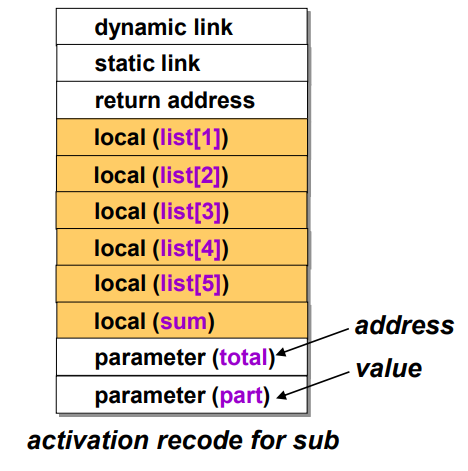
- Activation Record
- 특징
- 형식 & 크기 → compile 시점에 알 수 있음
- 형식은 instance 의 template
- Local 변수 : record 내의 storage 에 binding
- Static link (static scope pointer)
- static parent 가리킴
- nonlocal 변수 접근 시 사용
- Dynamic link
- dynamic parent (caller) 가리킴
- procedure 완료 시 stack 에서 제거할 때 사용
- Return address : 반환 주소
- Actual parameter : caller 가 제공한 값 or 주소
- 특징
◆ Example Without Recursion and Nonlocal References
program MAIN_1
var P : real;
procedure A(X:integer);
  var Y:boolean;
  procedure C(Q:boolean);
  begin
    P=P+1; <------------------- 3
  end
  begin
    …  <----------------------- 2
    C(Y);
    …
  end {end of procedure A}
procedure B(R:real);
  var S,T;
  begin
    …
    A(S);
    …
  end {end of procedure B}
begin {Main_1}
  …    <----------------------- 1
  B(P);
  …
end
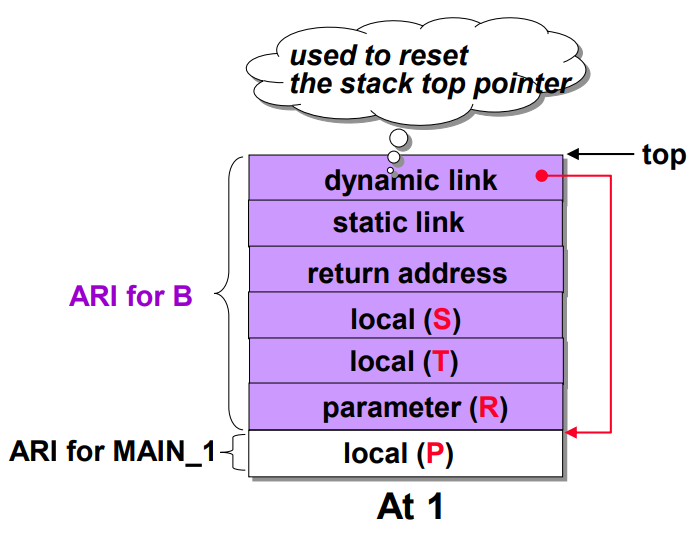
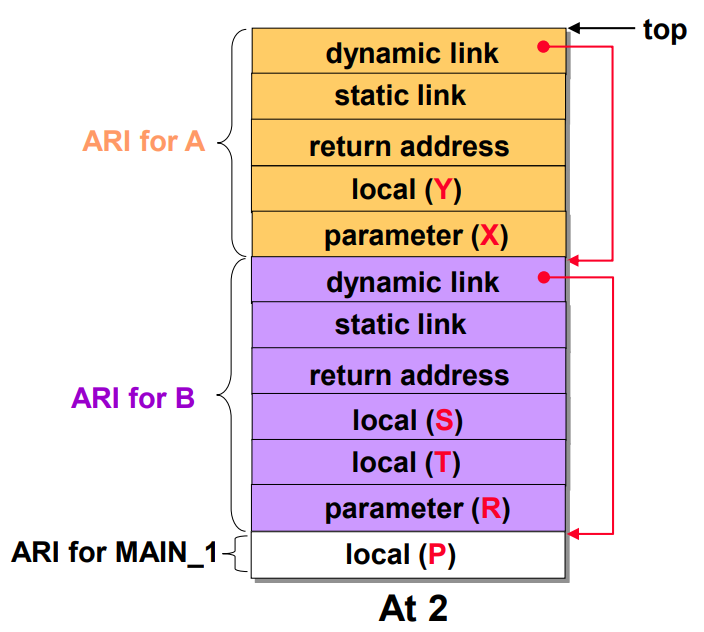
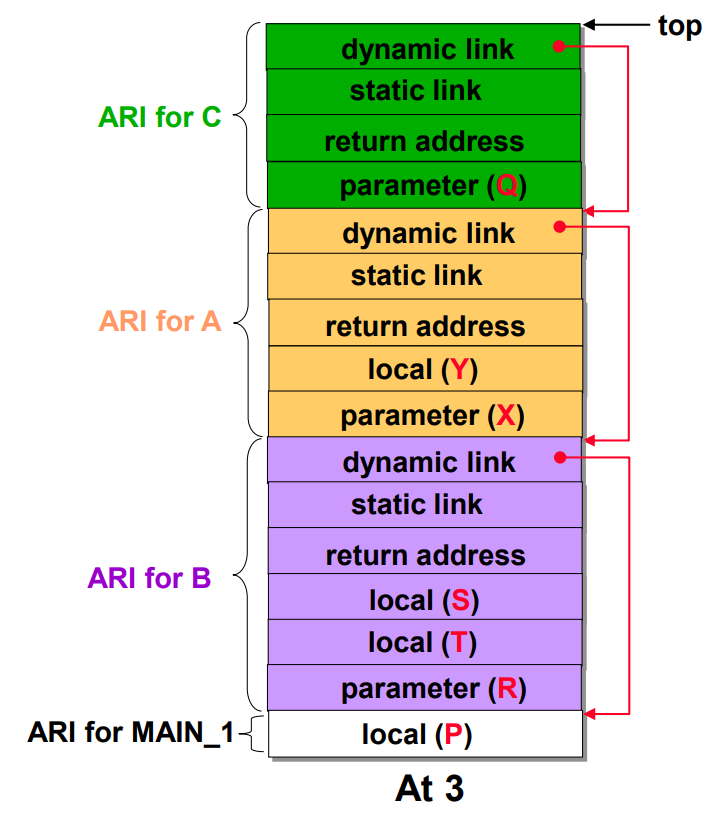
- 호출 순서 : MAIN_1 → B(P) → A(S) → C(Y)
-
1
-
2
-
3
-
- Dynamic Chan (call chain)
- 특정 시점에 stack 에 존재하는 dyamic link 의 집합
- 실행이 현 위치에 어떻게 도달했는지 dynamic history 나타냄
- Local_Offset
- local 변수 참조 → record 시작으로부터의 offset 으로 표현 가능
- local offset 은 compile 시점 변수의 순서, 타입, 크기 이용 결정
◆ Recursion
- 재귀를 이용한 factorial 계산
Program TEST
var VALUE:integer;
function FACTORIAL(N:integer);
begin  <----------------------------------- 1
  if N<=1
  then FACTORIAL:=1
  else FACTORIAL:= N*FACTORIAL(N-1);
end    <----------------------------------- 2
begin
  VALUE:=FACTORIAL(3);
  writeln("factorial 3 is:", VALUE)  <----- 3
end.
✦ Nested Subprograms
- nonlocal 변수 접근 매커니즘
- stack 어딘가에 존재
- nonlocal 변수 참조
- 해당 변수가 할당된 함수 stack 에서 찾기
- 변수에 접근 위해 변수의 local_offset 사용
- Static-scoped language 의 semantic rule
- subprogram 에서 static ancestor scope 에 선언된 변수만 nonlocal 하게 접근가능
- static ancestor 의 변수는 참조 시 stack 위에 반드시 존재
- 자신의 모든 static ancestor 가 active 해야 호출 가능
- 가장 close 한 nested 부터 바깥 쪽으로 탐색할 때 처음 발견되는 것
- Static chiain 사용
- Display 사용
◆ Static Chains
- Stack 내의 특정 함수들 연결하는 static link 들의 chain
- subprogram 의 ancester 를 부모부터 순서대로 연결
- nonlocal 변수 참조 발생 → 변수가 있는 함수 찾을 때 까지 static chain 탐색
- scope nest 는 compile 시점에 알 수 있음 → nonlocal 한 참조라는 것 & 필요한 static chain 길이 결정 가능
- Static_depth : 가장 밖 scope 에서 얼마나 깊이 중첩되어 있는가?
- Nesting_depth (chain_offset) of reference
- nonlocal 참조에 도달하기 위해 필요한 static chain 길이
- nonlocal 사용 static depth - nonlocal 선언 static_depth
- Example
program A ;
  procedure B ;
    procedure C ;
    end; { of procedure C }
  end; { of procedure B)
end ;
- static_depth : A(0), B(1), C(2)
- chain_offset : C 가 A 변수 참조 → 2 (2-0) - Example
MAIN_2
  var X : integer
  BIGSUB
    var A, B, C : integer ;
    SUB1
      var A, D : integer ;
      A : = B + C ;
    var B, E : integer ;
    SUB2
      SUB3
        var C, E : integer ;
        SUB1 ;
        E := B + A ;
      ....
      SUB3 ;
      ....
    A := D + E ;
  SUB2 ;
BIGSUB ;
- 호출 순서 : MAIN_2 → BIGSUB → SUB2 → SUB3 → SUB1
-
static_depth : MAIN_2 : 0, BIGSUB : 1, SUB2 : 2, SUB3 : 3, SUB1 : 2 SUB1에서 **
A := B + C** 참조 시:A는 SUB1 자신의 지역 변수 → chain_offset = 0-
B,C는 BIGSUB에 선언 → chain_offset = 1 (정적 링크 1번 이동) SUB3에서 **E := B + A** 참조 시: E는 SUB3 자신의 지역 변수 → chain_offset = 0B는 SUB2에 선언 → chain_offset = 1A는 BIGSUB에 선언 → chain_offset = 2
- Static chain 유지 방법
- subprogram 반환 시 : stack 에서 제거 → 추가 할일 X
- subroutine (값 반환 X subprogram) 호출 시 → 호출 시점 parent 의 가장 최근 activation record 찾아야 함
- run-time 에 dynamic chine 따라가며 탐색
- compile time : compiler 가 caller 랑 callee 사이 nesting_depth 계산 call time : caller 의 static link → caller 의 static chain 을 nesting_depth 만큼 내려가서 결정
- Static chain 문제점
- static parent 넘은 scope 변수 참조는 costly
- 참조 → 선언 도달하려면 static chain 한 link 씩 따라가야 함
- nonlocal 참조 비용 예측 难
- static parent 넘은 scope 변수 참조는 costly
◆ Display
- static link 를 actiavation record 가 아닌 display 에 모아 저장
- display : 단일 배열, 특정 시점에서 접근 가능한 activation record instance 주소 목록
- nonlocal 참조 : (display_offset, local_offset)
- display_offset : display 안에 있는 올바른 record 로의 link. static 하게 계산
- local_offset : static chain 과 동일 방식 계산 & 사용
- display 에 k 번째 위치 pointer → static_depth 가 k 인 activation record instance 가리킴
- display 수정 하기
- static_depth 가 k 인 procedure P 를 호출
- new record 에 display 의 k 번째에 위치한 pointer 복사본 저장
- display k 번째 위치에 P 의 record 로의 link 저장
- procedure 종료 : 종료되는 subprogram 의 record 에 저장된 pointer 를 다시 display 에 복원
- static_depth 가 k 인 procedure P 를 호출
-
Example
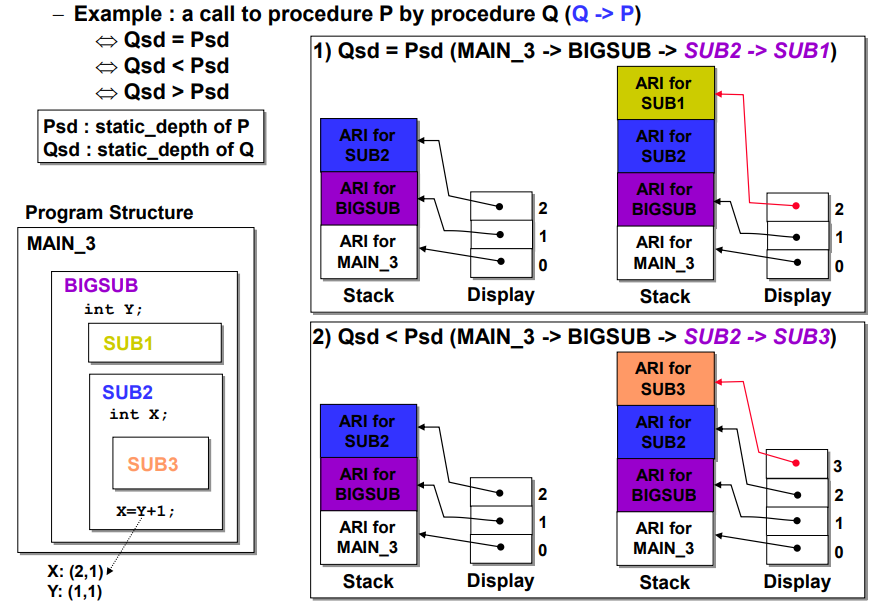
- 구현
- display 최대 크기 = subprogram 의 최대 static_depth → compiler 결정
- memory 에 runtime static array 로 저장
- memory 에 저장된 경우 → nonlocal 은 local 보다 memory cycle 한 번 더
- register 에 저장된 경우 → 추가적 memory cycle X
◆ Static chaining vs. Display method
- display 가 memory 에 저장 → nonlocal 참조 static chaining 보다 느림
- static level 이 1개 이상 떨어진 nonlocal 참조 → display 가 더 빠름
- display → all nonlocal 참조 시간 동일
- static chain → callee 가 static level 이 너무 안 멀면 유지 비용 더 good
- Overall comparison
- static nest 깊음, 먼 nonloacl 변수 참조 多 → Display
- nest 적음, 먼 nonlocal 변수 참조 少 → Static chaining (일반적)
✦ Blocks
- Block = 데이터 선언 + 여러 문장
- Block 구현
- 항상 같은 위치에서 호출되는 parameterless procedure 취급
- 최대 nest ↑ → Display 크기 ↑
- Block 변수에 필요한 공간 record 내의 local 변수 옆에 할당
- block 변수 offset 은 static 하게 계산 가능
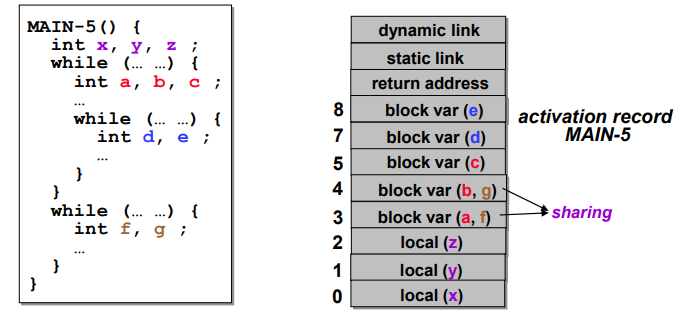
- block 변수 offset 은 static 하게 계산 가능
- 항상 같은 위치에서 호출되는 parameterless procedure 취급
→ while 동시에 동작 X : 같은 offset 공간 공유
✦ Implementing Dynamic Scoping
- nonlocal 변수들은 record 안에 있음 → stack 어딘가에 존재
- Dynamic scope 언어에서 nonlocal 참조 구현 방법
- Deep access
- Shallow access
◆ Deep access
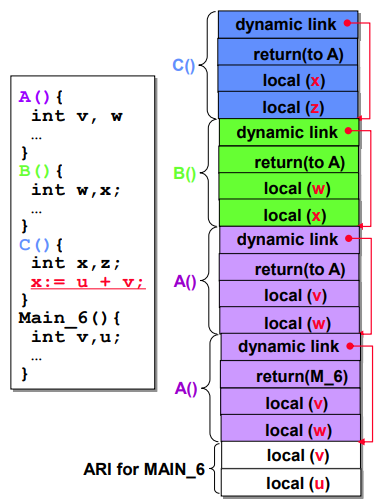
- 현재 active 한 다른 subprogram 의 선언 탐색 → 가장 최근 activated 된 것부터
- dynamic chaing 따라감
- dynamic scope 언어 → 탐색 chain 길이 compile 시점 결정 불가 → static scope 언어보다 느림
- record 에 변수의 이름 (name) 저장해야 함.
◆ Shallow access
- subprogram 내에 선언 변수 → 해당 subprogram ARI 에 저장 X
- 프로그램 전체에서 각 변수 이름마다 별도의 stack 유지
- 어떤 이름의 변수가 subprogram 시작 시 선언될 때 마다 해당 이름의 stack 에 cell 추가
- 해당 이름에 대한 참조 → stack top 변수 참조
- 참조 fast, subprogram 진입 & 종료 시 stack 유지비용 costly
공유하기
Twitter Facebook LinkedIn글 이동
시리즈 이동

Comments