[CS] Assembly: Array and Struct
'컴퓨터 시스템 개론' 시리즈
✦ Array
◆ One-dimensional array
- Allocation
T A[N];T→ typeA→ 이름N→ 원소 갯수
- memory 할당 :
N×sizeof(T)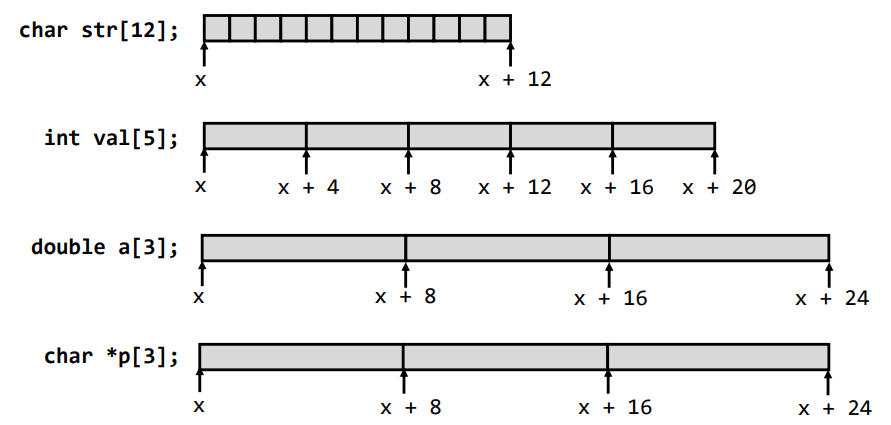
- Access
A(array name) 은 배열의 첫 번째 요소를 가리키는 pointer 로도 사용 가능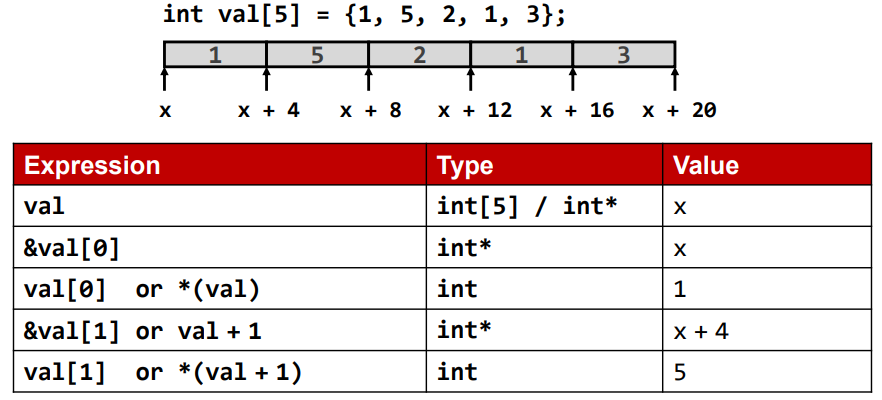
◆ Array & Pointer
- 항상 interchangeable X
char str1[32];
char str2[64];
char *p = str1;
- str1, p 는 같은 값 → 같은 address
sizeof(str1)= 32sizeof(p)= 8 → pointer- p = str2 → 가능 (가리키는 거 바꾸기)
- str2 = p → 불가능 (배열이 포인터?)
◆ Multi-dimensional (2D) Array
T A[N][M]Nrow /Mcolumns- size :
N×M×sizeof(T)
- Row-major ordering
- Table like 2-dimensional structure
- Array of array
- 각 행 하나하나가 1차원 배열
- memory 에선 linear 하게 저장되어 있음
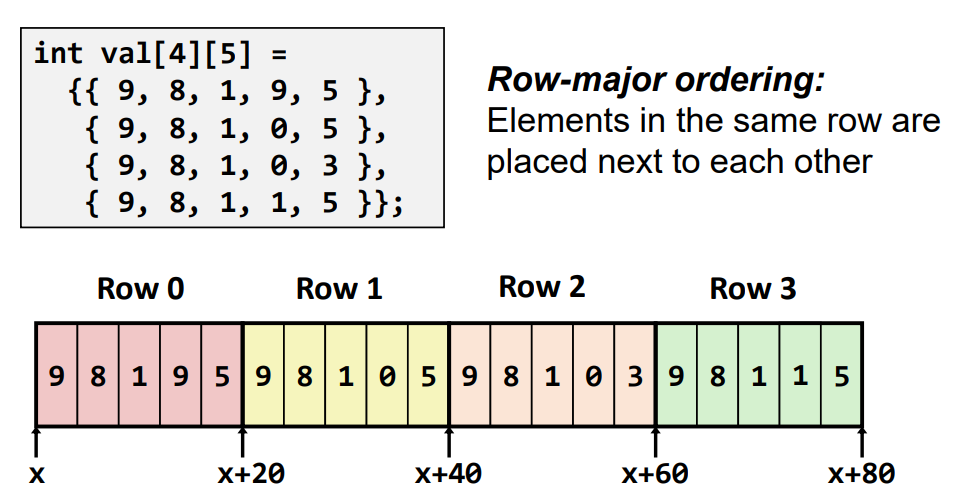
arr[i]의 시작 주소- arr[4][5] 와 같을 때 5개의 요소 만큼을 더해야 함

- arr[4][5] 와 같을 때 5개의 요소 만큼을 더해야 함
- In assembly
- Address access
int* get_row(int arr[][5], int row_idx) {
	return arr[row_idx];
}
movslq  %esi, %rsi
lea    (%rsi, %rsi, 4), %rax ; 5 × row_idx
lea    (%rdi, %rax, 4), %rax ; arr + 20 × row_idx
ret
- 2차원 배열을 input 으로 받음
- `lea` instruction 으로 memory 값 주소 계산만 해서 return   - Element access
int get_elem(int arr[][5],
						 int row_idx,
						 int col_idx)
{
	return arr[row_idx][col_idx];
}
movslq  %esi, %rsi
lea    (%rsi, %rsi, 4), %rax  ; 5 × row_idx
lea    (%rdi, %rax, 4), %rax  ; arr + 20 × row_idx
movslq  %edx, %rdx            ; col_idx
mov    (%rax, %rdx, 4), %eax  ; memory load
- `mov` instruction 으로 실제 값을 가져옴
◆ Array of Pointer
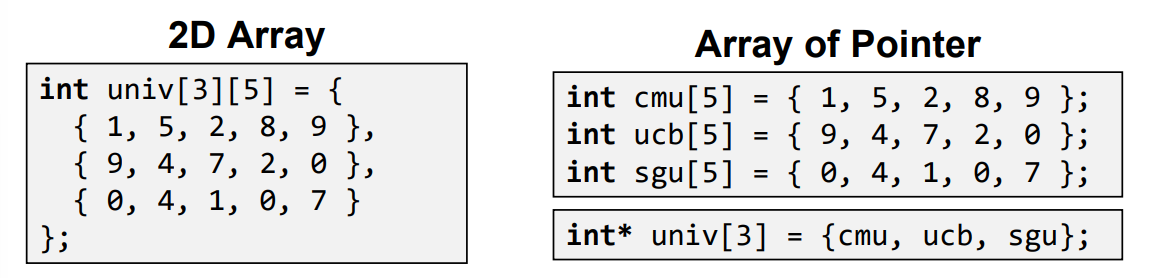
- 2차원 배열의 또 다른 표기 방법
- 이름 있는 1차원 배열들의 모음
-
Memory Layout
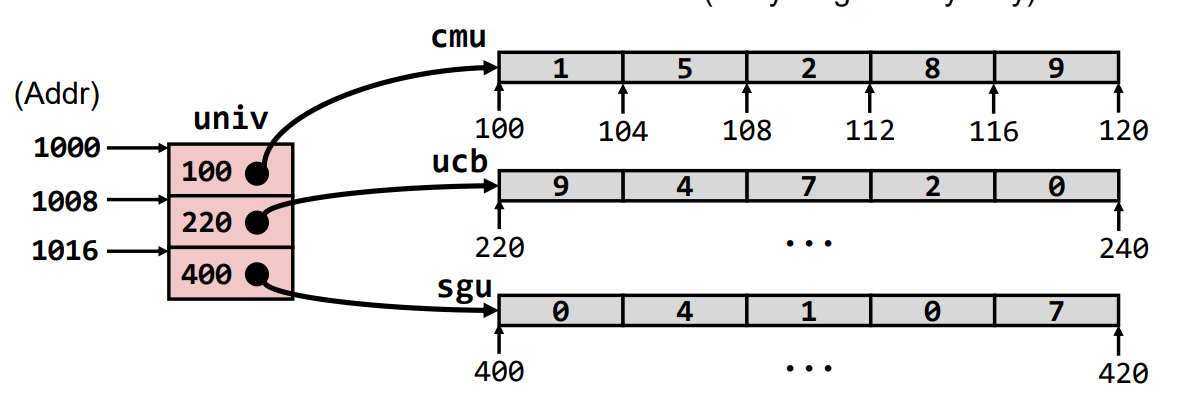
- 같은 배열끼리는 연속적, 배열 전체는 연속 X
univ는 포인터의 배열 → 각 요소는 8 byte
- In assembly
- Element Access
*(*(arr + 8 × ptr_idx) + 4 × int_idx)
- Element Access
int get_elem(int *arr[],
						 int ptr_idx,
						 int int_idx)
{
	return arr[ptr_idx][int_idx];
}
movslq  %esi, %rsi
mov    (%rdi, %rsi, 8), %rax   ; %rax = arr[ptr_idx(8)]
movslq  %edx, %rdx
mov    (%rax, %rdx, 4), %eax   ; return %rax[int_idx]
ret
◆ 2차원 배열 비교
- 2D Array
int get_elem(int arr[][5],
						 int row_idx,
						 int col_idx)
{
	return arr[row_idx][col_idx];
}
  - `*(arr+(20×row_idx)+(4×col_idx))`
- Array of pointer
int get_elem(int *arr[],
						 int ptr_idx,
						 int int_idx)
{
	return arr[ptr_idx][int_idx];
}
- `*(*(arr+(8×ptr_idx))+4×int_idx)` - C 코드 상에선 유사하지만, low level 에선 다르다.
◆ Common Mistakes
char strs[4][64]; // 2D array
char* ptrs[4];    // Array of char*

strcpy(strs[1], "ABC");  // (1)
strcpy(ptrs[1], "ABC");  // (2)
strs[2] = "DEF";         // (3)
ptrs[2] = "DEF";         // (4)
- correct
- segment fault
ptrs[1]→ 초기화 X 쓰레기 주소. 이상한 곳 접근하려 해서 seg fault 발생
ptrs[1] = (char*) malloc(4);
strcpy(ptrs[1], "ABC");
- compile error
- 대입 → pointer 가능 / array 불가능
strs[2]자체는char[64]→ 대입 불가strcpy사용 해야함
- correct
✦ Struct
◆ Struct in C
struct Student {
	int id;
	char name[MAXLEN];
	double GPA;
};

struct Student s, *ps;
struct Student CSE3030[150];

s.id = 20230123
ps = &s;
printf("Student ID: %d\n", ps->id);
struct의 각 변수 → field 라고 부름- 정의 자체는 변수 X, data type 처럼 사용
- memory → 연속된 block 처럼 표현
struct node {
	int a[4];          // 4(int) * 4
	long l;            // 8(long)
	struct node *next; // 8(pointer)
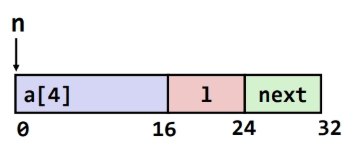
- compiler 가 전체 size 결정
- assembly 에선 offset 이용 접근
- Example
void set(struct node *n, int v, int idx) {
	while (n) {
		n->a[idx] = v;
		n = n->next;
	}
}
0x401106 <+0>:  jmp 0x401112 <set+12>
0x401108 <+2>:  movslq %edx,%rax       ; %rax: 'idx'
0x40110b <+5>:  mov %esi,(%rdi,%rax,4) ; n->a[idx] = v;
0x40110e <+8>:  mov 0x18(%rdi),%rdi    ; n = n->next
0x401112 <+12>: test %rdi,%rdi
0x401115 <+15>: jne 0x401108 <set+2>   ; if (n) goto ...
0x401117 <+17>: ret
0x18→ 24 (next 의 offset)
◆ Alignment
- 어떤 data type 이 K byte 면, 그 타입의 변수는 K 의 배수에 위치해야 함
- ex) int type 은 메모리 시작 위치 → 4의 배수
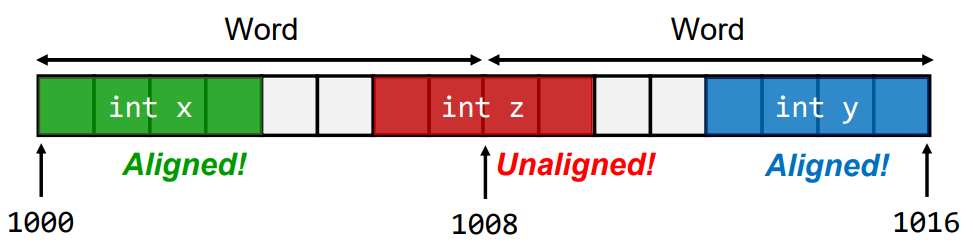
- ex) int type 은 메모리 시작 위치 → 4의 배수
- Why? 하드웨어 레벨에선 word 단위로 메모리 접근
- alignment 필수인 CPU도 존재, x86 에서는 recommended
◆ Structure Alignment
struct S1 {
	char c;    // 1
	int i[2];  // 4
	double d;  // 8
	short s;   // 2
};
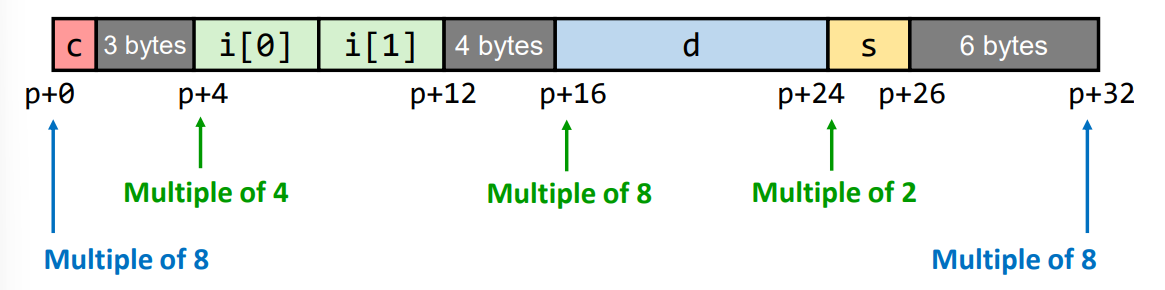
- 각 요소는 align 된 위치에 놓여야 함
→ padding 통해서 위치 맞추기
- int → 4의 배수
- double → 8의 배수
- short → 2의 배수
- struct 전체 길이 → struct 안의 가장 큰 size 의 배수에 맞추기 (8 byte)
◆ Array of Struct
- struct size * 배열 요소 만큼 배치
struct S2 {
	short i;
	int j;
	short k;
};

struct S2 a[8];
-
a 배열 개당 12 byte

-
struct 배열의 요소 구하기
short get_k (struct S2 arr[], int idx) {
	return arr[idx].k;
}
movslq  %esi, %rsi
lea    (%rsi, %rsi, 2), %rax     ; %rax = idx * 3
movzwl  0x8(%rdi, %rax, 4), %eax ; %rax = arr[] + idx * 12 + 8
ret
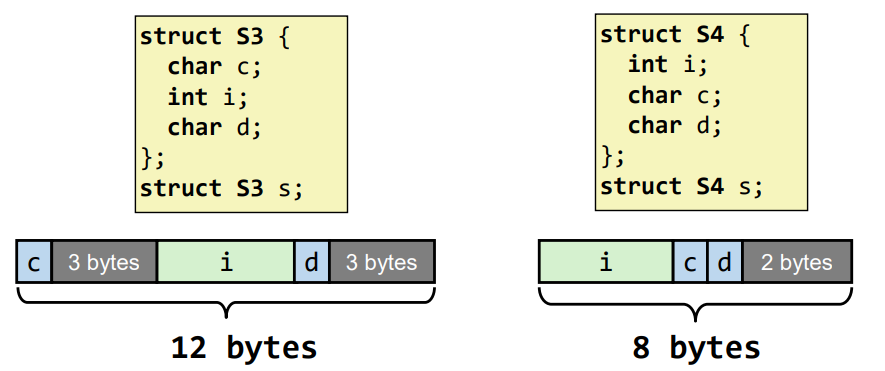
◆ Saving Memory Space
- alignment 를 고려해 struct 를 만들면 memory 공간 절약 가능
공유하기
Twitter Facebook LinkedIn글 이동
시리즈 이동

Comments